Liquidity Sweep Explained: Stop Runs & How to Trade Them
What a liquidity sweep actually is, why price keeps running the obvious highs and lows, how to tell a sweep from a real breakout, and two real trades where I faded one.
The short version
- A liquidity sweep is price trading just beyond an obvious high or low, triggering the orders resting there, then reversing back inside.
- It's the same move traders have called a stop run, a failed breakout, or in market profile a failed auction, for decades.
- Price goes there because that's where the orders are. Nobody is hunting your stop personally.
- The edge is telling a sweep from a real breakout, and you can only do that by watching the reaction. Order flow makes that much clearer.
Like the fair value gap, the liquidity sweep is one of those terms that's everywhere right now. And like the fair value gap, the idea behind it is real and very old. I trade it almost every week. I just call it a stop run.
So this page does two things. It explains the concept properly, and it shows you how I actually trade it on futures, with two real trades of mine, because the definition is the easy part. Knowing when a sweep has failed and when it's about to become a breakout is where the money is.
What Is a Liquidity Sweep?
A liquidity sweep is when price pushes through an obvious high or low, triggers the orders that were waiting just beyond it, and then reverses back inside the range.
Think about what sits above a clean high that everyone can see:
- Buy stops from short sellers. Everyone who shorted below the high put their stop just above it. A stop on a short is a buy order.
- Breakout buy orders. Traders waiting to buy "when it breaks" have buy stops sitting there too.
When price reaches that level, all those buy orders trigger at once. If a big player wanted to sell size, that burst of buying is the perfect counterparty. They can fill a large sell order without pushing price down against themselves. Once those orders are used up, there's nobody left to buy, and price falls back into the range. The same thing happens in reverse below an obvious low, where long traders' sell stops sit.
Where sweeps happen
Sweeps happen where stops cluster, which is anywhere obvious:
- The prior day's high and low
- The overnight (globex) high and low, which I mark every morning in my premarket routine
- Equal highs or equal lows, where price stopped at the same place twice
- The initial balance high and low, the range of the first hour
- Round numbers on ES and NQ
The Honest Part: One Move, Many Names
Traders have been trading this move for as long as there have been stop orders. It just keeps getting new names:
| Name | Where it comes from |
|---|---|
| Liquidity sweep / liquidity grab | ICT and smart money concepts content |
| Stop run / stop hunt | Floor and futures traders, for decades |
| Failed breakout / false breakout | Classic technical analysis |
| Failed auction, "look above and fail" | Market profile |
| Spring / upthrust | Wyckoff |
| Turtle Soup | A named setup from Linda Raschke and Larry Connors that fades failed 20-day breakouts |
None of these names is wrong, and liquidity sweep is actually a pretty good description of what happens. But if you've only learned it under one name, it helps to know you're looking at one of the oldest setups in trading. That tells you two useful things. It works often enough that people keep rediscovering it, and plenty of people are watching for it, so the obvious version doesn't always pay.
One more honest point about "stop hunt". Nobody is hunting your stop specifically. Large traders need someone on the other side of their orders, and the biggest pile of orders sits right beyond the obvious highs and lows. Price goes there because that's where the business is. Once you see it that way, the move stops feeling personal and starts looking like an opportunity.
Liquidity Sweep vs Breakout: The Only Question That Matters
Every breakout starts by running the stops above the high. So does every sweep. At the moment the level breaks, they look identical. The difference only shows up in what happens next.
| Real breakout | Liquidity sweep | |
|---|---|---|
| After the break | Price holds above the level and builds there | Price can't hold and comes back inside quickly |
| Delta | Aggressive buying keeps moving price | Aggressive buying gets absorbed, price stalls |
| Profile | Acceptance: value starts moving higher | Rejection: a tail or single prints above the high |
| Your job | Don't fade it | Look for the short back into the range |
This is why I never fade a level just because price went through it. Fading every new high is how traders get run over on trend days. I wait for the market to show me the breakout failed.
How I Trade a Liquidity Sweep (Two Real Trades)
My process is the same one I use at every level, read on a footprint chart: level, then absorption, then exhaustion, then entry when price moves my way for the first time.
Trade 1: Stop run through the overnight high
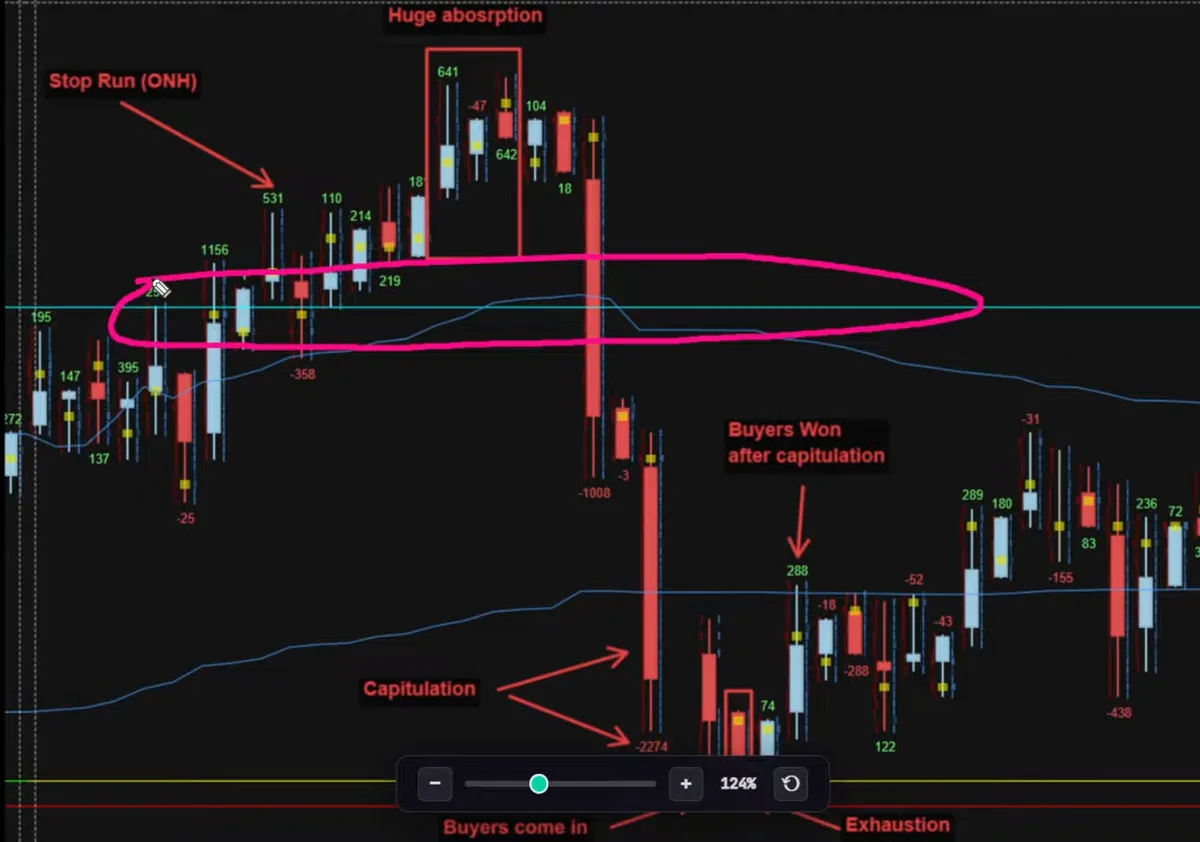
Price ran through the overnight high with +1,156 delta. That's the sweep: aggressive buyers piling in as the level broke, including every short's stop. Then it stopped working. One bar printed +641 delta and price rejected instead of going higher, so those buyers got absorbed. The next bar printed −47 and price went up, so sellers were getting absorbed too. A fight above the high.
Buyers made one last push with +104 and got nowhere. Then heavy market selling came in and price moved down for the first time. That's where I shorted, with the stop above the high of the sweep. The full read of this trade is in my footprint chart guide.
Trade 2: Stop run into the daily highs on YM
On YM I had the daily and overnight highs marked, and two scenarios. Either price breaks out and goes for the single prints above, or it runs the highs, fails and rotates back into value. Price ran the highs with +136 delta. Absorption kicked in at the level, and over the next few rotations aggressive sellers started outpacing the buyers. Buyers got one last push of +31, then the next rotation came back down. I shorted 5 contracts with the stop behind the daily high, and targeted the naked POC, the previous close and the overnight single prints below.
The written version, including why I didn't add to the trade, is in the YM stop run trade review.
The checklist
- A level everyone can see. Prior day high or low, overnight high or low, equal highs or lows.
- The run. Price trades through it, usually with a burst of aggressive orders.
- Absorption beyond the level. Big delta that doesn't move price any further.
- Exhaustion. A last push that goes nowhere.
- Back inside. Price moves back into the range, and that's the entry.
- Stop beyond the sweep's extreme, sized with real risk management. Targets back inside: VWAP, the POC, or the other side of the range.
Liquidity Sweep Mistakes I See Most
- Fading the first wick. A wick through the high isn't a failed breakout yet. Wait for absorption and for price to come back inside.
- Fading trend days. On a strong trend day every high gets "swept" and then broken anyway. If value is moving with price, stand aside.
- A stop one tick above the sweep. The sweep's high often gets tested again. Give the stop room, and size down to keep the risk the same.
- Calling everything a sweep in hindsight. On a finished chart every reversal looks like a sweep. In real time you need the level and the reaction, or it's just a story.
- Taking it personally. If your own stop keeps getting run, the fix is placing stops where the trade is actually wrong, not where everyone else puts theirs.
Liquidity Sweep FAQ
What is a liquidity sweep?
Price trading just beyond an obvious high or low, triggering the stop and breakout orders resting there, then reversing back inside the range. Traders have long called it a stop run or a failed breakout.
What is the difference between a liquidity sweep and a liquidity grab?
There's no real difference. Some traders use grab for a quick wick through the level and sweep for a slightly bigger move, but you read and trade them the same way.
Is a liquidity sweep the same as a stop hunt?
Same move, different story. Large traders need someone to trade against, and the biggest pool of orders sits beyond obvious highs and lows. Price goes there because that's where the liquidity is, not to hunt your stop.
How do you tell a liquidity sweep from a breakout?
By the reaction. A breakout holds above the level and keeps moving on aggressive buying. A sweep can't hold, the buying gets absorbed, and price comes back inside. You can't know at the moment the level breaks, so wait.
How do you trade a liquidity sweep?
Mark the obvious levels, wait for price to run one, then look for absorption, a failed last push and price moving back inside. Enter there, stop beyond the sweep's extreme, target the next level back inside the range.
Do liquidity sweeps work in futures?
Futures are one of the best places to trade them, because a footprint chart shows you the actual orders at the new high or low, so you can see the sweep failing instead of guessing.
Want me to watch your levels and your entries with you, live?
See 1-on-1 MentorshipKeep reading: Fair Value Gap Explained • Order Blocks Explained • Footprint Chart Trading • Absorption Trading • YM Stop Run Trade Review • Market Profile Guide • All Free Resources