How to Trade ES Futures
To trade ES futures you need a futures broker, a platform, and enough money for the stop you'll actually use. One ES is $50 a point, so a 10-point stop is $500, and a normal 2026 day moved 65 points, about $3,240 per contract. Most people should start on MES at $5 a point. Here are the specs, how the ES day actually flows, how I trade it every morning, and what you need to start.
Published July 20, 2026 with current index levels and margins
Updated · by Joakim Jusell
ES is the E-mini S&P 500, the most traded equity index futures contract in the world, and it has been my home base for years. I'm in it live every morning alongside YM and RTY, so this guide is not a rewritten broker spec sheet. It's how the contract actually behaves and how I approach it, session after session.
If you're brand new to futures, you can still follow along. I define everything as it comes up, and where a topic deserves its own deep dive I link the full guide.
The Short Version
ES is the E-mini S&P 500 futures contract on CME. Each point is worth $50, each 0.25 tick is $12.50, and it trades nearly 24 hours a day from Sunday evening to Friday. The best trading happens in the first two hours after the 9:30 AM ET open. To day trade it with sane risk you realistically want $20,000 or more, and below that you trade MES, the micro version at $5 per point. The path that works: sim first, then micros, then ES, with a journal proving every step.
What ES Actually Is
One ES contract is an agreement on the future value of the S&P 500 index, which tracks 500 of the largest US companies. You never own any stocks. You're trading the index level itself, with leverage, nearly around the clock, and you can go short as easily as long. That's the whole appeal of index futures for day traders.
With the S&P 500 around 7,500 as I write this, one contract controls roughly $375,000 of exposure. Read that again if you're new. That's why the risk section of this guide matters more than the strategy section.
| Underlying index | S&P 500 |
| Point value | $50 per point |
| Tick size / tick value | 0.25 points / $12.50 |
| Notional value (July 2026) | ~$375,000 (S&P @ 7,500) |
| Typical daily range (RTH) | 40-80 points ($2,000-4,000 per contract) |
| Average daily volume | ~1.5-2 million contracts |
| Bid-ask spread | 1 tick, almost always |
| Day trade margin (typical) | $500 - $1,000 per contract |
| Overnight margin (approx.) | $12,000 - $15,000 |
| Micro version | MES ($5 per point, $1.25 tick) |
| Hours | CME Globex, Sun 6 PM - Fri 5 PM ET, daily break 5-6 PM |
One practical thing nobody tells beginners: ES has quarterly expirations in March, June, September, and December. You always trade the front month, and about a week before expiration everyone rolls to the next contract. The clean way to time it is to just look at volume. Pull up both contracts and trade whichever one is doing more volume, because the higher volume contract is the more liquid one, and liquidity is the whole reason you're in ES. Your platform usually handles the symbol switch, but if your chart ever looks dead and weird near those months, you're probably still on the expiring contract.
Margins vary by broker and CME adjusts them with volatility. Always check your broker's current numbers.
How the ES Day Actually Flows
ES trades almost 24 hours, but the day has a rhythm, and knowing it is worth more than most indicators. All times Eastern.
| Time (ET) | What's happening | My take |
|---|---|---|
| 6 PM - 8:30 AM | Overnight session. Asia, then Europe. Thin volume, slower moves. | I don't trade it, but the overnight high and low become two of my most important levels for the day. More on reading the premarket. |
| 8:30 AM | The big data slot: CPI, jobs report, jobless claims, GDP. | On release days the candle at 8:30 can be 30+ points in seconds. I never hold a position into it. |
| 9:30 - 11:30 AM | Cash open. Real volume arrives, the day's ranges get built. | This is my window. Best volume, best range, cleanest reads. Most of my trades happen before 11. |
| 11:30 AM - 1:30 PM | Lunch. Volume dries up, price chops around in a range. | I'm done for the morning. Lunch chop has taken more small accounts than any crash ever did. |
| 2:00 PM | FOMC statement on Fed days, eight times a year. | Fed days are their own animal. If you're new, flat is a position, and it's the right one at 2 PM. |
| 2:00 - 4:00 PM | Afternoon session. Volume returns, trends often resume or reverse. | Second best window of the day. Cleaner than lunch, but I've usually hit my plan by then. |
| 3:50 - 4:00 PM | Market-on-close imbalances hit, big funds finish their business. | Fast, institutional, and not a place to learn. Watch it, don't trade it. |
Notice what that table really says: out of a nearly 24-hour market, the part worth a day trader's attention is maybe four hours, and the best of it is two. Trading less of the day is one of the fastest upgrades available to a struggling trader, and it costs nothing.
What Moves ES
Day to day, ES runs on a short list of things. Macro data is the big one: inflation prints, the jobs report, and anything the Fed says will move it more in one candle than a normal hour of trading. Earnings from the megacap tech names matter too, because those companies are a huge slice of the index, and their after-hours reports show up as overnight gaps.
And then there's the market's own structure. A huge share of ES movement is just price traveling between levels that everyone can see: yesterday's high and low, the overnight range, the big round numbers, the prior week's extremes. Nothing mystical about it. Enough traders and algorithms watch the same references that the references become real.
The last input is its siblings. I keep NQ, YM, and RTY on screen next to ES all day, because which index is leading tells you what kind of day it is. Tech dragging everything higher is a different tape than small caps leading a rotation. That relative strength read is free, and it's one of the most useful signals in index futures.
My ES Futures Trading Strategy: How I Actually Trade It
My whole approach fits in two steps: location first, confirmation second.
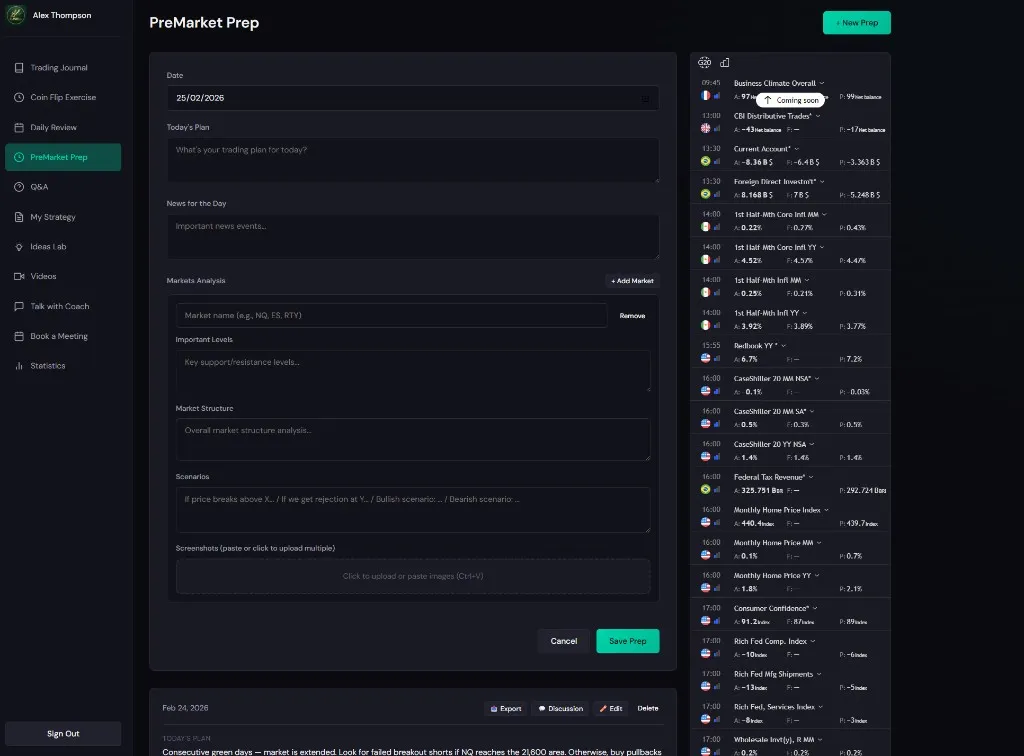
Location means levels. Before the open I mark the handful of prices that matter: prior day high and low, overnight high and low, the value area, and any big level left over from previous sessions. That's my map for the day, and it's done before 9:30. One setup I see at those levels again and again is a stop run through the overnight high or low, which I break down in liquidity sweep explained. My pre-market checklist walks through the exact routine.
Confirmation means order flow. When price reaches one of my levels, I don't guess whether it will hold. I watch what actually trades there: is size absorbing the selling, is delta shifting, are the aggressive orders getting rewarded or trapped? That's the part indicators can't show you, and it's the core of what I teach. The full method is in my order flow trading guide, with the specific triggers in order flow entry signals and the deepest concept, absorption, in its own guide. The exact read I use is in my footprint chart guide.
ES is the best contract in the world for this style, and it's a big part of why it's my home base. The order book is deep, so the levels hold real size and the DOM is readable. On a faster, thinner contract like NQ the same read is twice as hard. I compared the two properly in NQ vs ES if you're weighing them.
What I don't use might matter more: no oscillators, no signal services, no twelve-indicator charts. Price, volume, and a few levels. The edge comes from reading the auction, not decorating it. If volume tools are new to you, start with the volume profile and VWAP guide.
What a Real ES Trade Looks Like
Here's the shape of a bread-and-butter trade, with real dollars attached so you can feel the size of the thing.
Say ES sold off early and is now approaching yesterday's low, one of my marked levels. I'm not shorting into it and I'm not blindly buying it either. I watch. Sellers keep hitting the bid at the level but price stops going down, and the footprint shows big passive buying soaking up everything sold into it. That's absorption. Sellers are trying, and failing. When the failure is obvious, I go long against the level.
Stop goes a couple of points below where the buying showed up, call it 8 points of risk, which is $400 per contract. Target is the next reference above, maybe 12 points away, which is $600 per contract. If the level breaks instead, I'm out for the $400 and nothing about my day changes, because that risk was budgeted before the trade existed.
That's it. No prediction, no hero calls. A marked level, evidence at the level, defined risk, defined target. The wins aren't spectacular and the losses aren't either, and that boring symmetry, repeated a few hundred times, is the actual job.
How Much Money You Actually Need
Your broker will let you trade one ES on $500 of day margin. This number has destroyed more new futures traders than any other, so let's be clear about what it is: the minimum deposit to hold the position, not a suggestion about account size.
Sizing starts from the stop. A sensible ES stop is 8-10 points, which is $400-500 per contract. For that to be 1-2% of your account, the account needs to be $20,000-40,000. Trade one ES in a $2,000 account and every normal stop-out costs you 20-25%. Four losers in a row, which happens to everyone, and the account is basically gone. The math was never on your side, no matter how good the entries were.
Under $20,000? Trade MES.
MES is the identical chart at exactly 1/10th the size: $5 per point, $50 stops instead of $500. A $3,000-5,000 account can trade the same setups with survivable risk, and everything in this guide applies tick for tick. I wrote the full comparison in MES vs ES, and a complete guide to all four micros. There is no shame in micros. There's plenty of shame in donating a small account to the day-margin casino.
The Mistakes That Empty ES Accounts
After years of trading this contract and mentoring people on it, the failure list is surprisingly short. It's the same handful of mistakes, over and over.
Starting From Zero: The Path That Works
If you're new, here's the honest sequence. Nothing about it requires prior experience. It just requires doing the steps in order instead of skipping to the end.
How long does this take? Longer than the marketing says and shorter than doing it wrong. I wrote honestly about the timeline in how long it takes to become profitable. And if you want the sequence supervised instead of solo, that's literally what my mentorship is. Some of my best students started as complete beginners, because there were no bad habits to undo first.
Questions I Get About Trading ES
Is $500 enough to trade futures?
Enough to open a trade, not enough to trade well. Day-trading margin on MES is often $50 to $100, but a normal 2026 day moved $325 on one MES and a 10-point stop is $50, which is 10% of a $500 account. Practice on sim, or save up to $2,500 or more before trading real money.
Do I need $25,000 to trade futures?
No. The $25,000 pattern day trader rule is a stock rule. It doesn't apply to futures, so you can day trade ES or MES as often as you like with any account size your broker accepts. What you need is enough capital for your stop: about $2,500 for MES, and $25,000 or more for ES.
How much money do you need to trade ES futures?
To day trade one ES contract with sane risk (1-2% per trade against an 8-10 point stop), you realistically want a $20,000-40,000 account. Brokers will let you trade it on $500-1,000 day margin, but trading at margin minimums means a single normal stop-out costs 40%+ of a small account. Under $20,000, trade MES instead: same chart at $5 per point.
What is the best ES futures trading strategy?
The one I use is location first, confirmation second. Before the open I mark the prior day high and low, the overnight high and low and the value area. Then I only trade when order flow confirms at one of those levels. No indicators and no signals. Whatever strategy you pick, it needs a clear level, a clear reason to be wrong and sizing you can repeat.
Are ES futures good for beginners?
Yes, and ES is actually the best index futures contract to learn on because it's the most liquid and moves in the most orderly way. The path that works: learn the basics, trade a sim account until your journal shows consistency, then go live on MES (the micro version) before sizing up to full ES. Skipping straight to live ES on day margin is how most new accounts die.
What are the best hours to trade ES futures?
The first two hours after the 9:30 AM ET open have the best combination of volume, range, and clean price action, and that's where I do most of my own trading. The 2:00-4:00 PM ET afternoon session is second best. The lunch hours from roughly 11:30 AM to 1:30 PM are thin and choppy, and most consistent day traders simply skip them.
Is ES good for day trading?
ES is arguably the best day trading contract in the world. It trades well over a million contracts a day, the spread is one tick almost all the time, it respects technical levels better than faster contracts like NQ, and the deep order book makes order flow readable. That combination of liquidity and orderliness is why so many professional day traders make it their main market.
Want to learn ES with someone watching your trades every day?
Book Your Intro Session ($20)Continue learning: RTY Futures Explained • Opening Range Breakout Test • Order Flow Trading Guide • Micro Futures Guide • MES vs ES Futures • NQ vs ES Futures • Risk Management • Pre-Market Checklist • Day Trading for Beginners • All Free Resources