What Is Day Trading? How It Works and the Real Risks
How it actually works, the strategies that pay, and the risks nobody talks about. Written from inside the chair.
Published · Updated · by Joakim Jusell
Day trading is one of those topics where almost everything written online either oversells it or scares you off. The truth sits somewhere in the middle and it depends a lot on what market you trade, how you size, and how much screen time you put in.
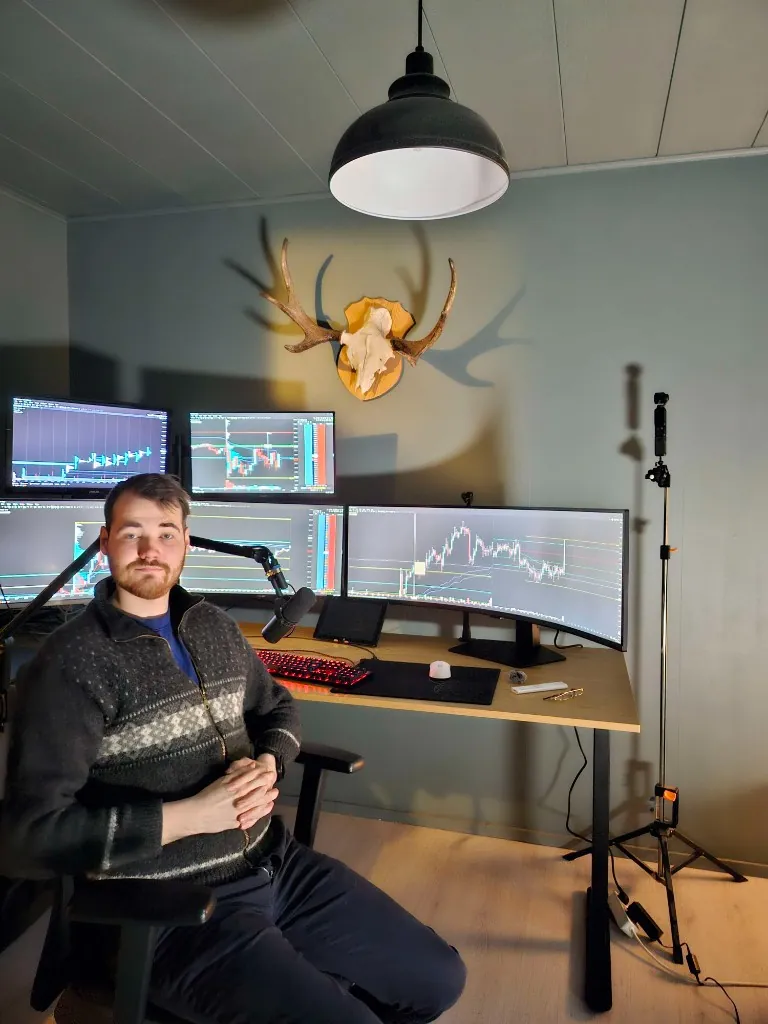
This guide is from a full-time futures day trader. I'll walk you through what day trading actually is, how it works (with a clear bias toward futures because that's what I trade and where most serious intraday traders end up), the most common strategies, how it compares to swing trading, and the risks that hit you in year one.
What Is Day Trading?
Day trading is the practice of opening and closing positions in the same session, usually in liquid instruments like index futures, stocks, options, or forex. By definition, a day trader does not hold positions overnight. Every trade is opened and closed before the market closes (or, for futures, before the daily settlement).
The goal is simple: profit from the intraday price action instead of holding for the long term. Where investors care about a company's 5-year earnings, day traders care about what happens in the next 30 minutes around a key level, an economic release, or a shift in order flow.
Most professional day traders focus on a small handful of instruments. I trade index futures (ES, YM, RTY) almost exclusively. That focus matters. The trader who's seen 10,000 ES opens reads the tape faster than someone who jumps between 30 stocks every week.
How Day Trading Works
Day trading works because markets are not perfectly efficient inside a single session. There are real, repeating patterns: stop runs into key levels, opening drives, mean reversion in balance, exhaustion at session highs, absorption before a reversal. A day trader's job is to learn 1-3 of those patterns deeply and execute them with discipline.
A typical day looks something like this:
-
Pre-market prep.
Mark overnight high/low, prior day's RTH high/low, key levels, point of control, and the day's economic calendar. Define a directional bias and the levels that would invalidate it. This is non-negotiable. Use a pre-market checklist if you don't already have one.
-
Wait for your setup.
You're not trying to catch every move. You're waiting for the specific setup you've defined and tested. If it doesn't show up, you don't trade. Most blowups happen because traders force trades when their actual setup isn't there.
-
Execute with a plan.
Entry, stop, and target are defined before you click buy. Risk per trade is fixed (usually 0.5-1% of account). The decision is made when you're calm. Then you just execute.
-
Manage and exit.
Most trades are managed actively: trailing stops, scaling out at the first target, holding a runner for a bigger move. Exits are where most edge gets given back.
-
Review the session.
Every trade. Every mistake. What did the market actually do, and how did you act. This is where the next month's improvement comes from. The free daily review tool we built does this in about 5 minutes.
The Most Common Day Trading Strategies
Almost every day trading approach falls into one of these buckets. Pick one, master it, and ignore the rest until you're consistent.
1. Scalping
Scalpers take many trades per session, often holding for seconds to minutes. The goal is small consistent gains, usually 1-3 ticks on instruments like MES or MNQ. Scalping demands fast execution, low commissions, and high focus. It's not better or worse than other styles, but it's brutal on commissions and emotionally draining over a long session. Most "scalpers" I've watched lose money are actually just overtrading.
2. Momentum / Trend Day Trading
Momentum traders identify a strong intraday trend (often confirmed by a breakout, volume surge, or news catalyst) and ride it with a runner. On a strong trend day in ES, this might mean entering on a pullback to VWAP and holding for 20-30 handles. The win rate is lower than scalping but the reward-to-risk is much higher.
3. Breakout Trading
Breakout traders wait for price to push through a key level (overnight high, prior day high, opening range) and enter in the direction of the move. The catch: most breakouts in index futures fail. Real breakout traders learn to filter which breakouts are likely to follow through (volume confirmation, where the breakout sits relative to higher-timeframe levels, time of day). Otherwise you're feeding the stop-runners.
4. Reversal / Mean Reversion Trading
Reversal traders fade extremes, looking for exhaustion at session highs/lows or rejection at major levels. Order flow tools like delta divergence, absorption, and footprint exhaustion are core to this style. The advantage is that the stop is usually small and the reward is large. The disadvantage is that you're trying to time tops and bottoms, which is hard. This is my preferred style: most of my best trades come from fading exhaustion at key levels with order flow confirmation.
5. Order Flow Trading
This isn't really a separate strategy. It's a lens. Order flow traders use the actual buying and selling behavior at price (delta, footprint, volume profile, market depth) to refine their entries. For futures specifically, learning to read order flow gives you an edge that's almost impossible with traditional indicators alone. We covered the full breakdown in how order flow beats traditional indicators.
Day Trading vs Swing Trading
The two get conflated all the time but they're very different jobs. Here's a side-by-side:
| Aspect | Day Trading | Swing Trading |
|---|---|---|
| Holding period | Minutes to hours, never overnight | 2 days to several weeks |
| Charts used | 1m, 5m, 15m intraday | 4H, daily, weekly |
| Trades per week | 5-30+ | 1-5 |
| Time commitment | 2-6 focused hours per day | 30-60 minutes per evening |
| Capital required | $2K-5K (futures micros) or $25K+ (US stocks PDT) | $5K-25K depending on instrument |
| Overnight risk | None | Yes, including gaps on news |
| Stress level | High during session, off after close | Lower per-day, but constant background |
| Best for | People who can sit at the screen during market hours | People with day jobs or other commitments |
If you have a 9-5 and you can't watch the screen between 9:30am and 4pm ET, swing trading is the more honest answer. Don't try to day trade with a phone in a meeting. It doesn't work.
Why Most Serious Day Traders Trade Futures
You can day trade stocks, options, forex, or crypto. But most full-time day traders end up in futures, especially index futures. Here's why:
-
No PDT rule.
The Pattern Day Trader rule that requires $25,000 to take more than 3 day trades per week applies to US stocks. It does not apply to futures. You can take unlimited day trades with a $2,000 account.
-
Nearly 24-hour markets.
Index futures (ES, NQ, YM) trade roughly 23 hours a day. You can trade the European session, US open, or US close depending on your schedule. Stocks only really move during regular trading hours.
-
Deep liquidity, tight spreads.
The ES and NQ are two of the most liquid markets on earth. You can get filled instantly with no slippage on most retail size. Try doing that on a small-cap stock.
-
Tax treatment (US).
Futures get 60/40 tax treatment in the US: 60% long-term capital gains, 40% short-term, regardless of how long you held. Over a profitable year that's a meaningful difference vs short-term stock gains.
-
Micro contracts.
MES, MNQ, MYM, M2K let you trade the same indices at 1/10 the size. You can size up gradually as you prove consistency. We compared the two in detail in MES vs ES.
The Real Risks of Day Trading
Day trading by the numbers
- 97% of Brazilian futures day traders who kept going for more than 300 days lost money (Chague, De Losso & Giovannetti, 2019).
- Less than 1% of day traders in Taiwan were predictably profitable after fees (Barber, Lee, Liu & Odean, 2014).
- What profitable traders actually earn, and why account size matters so much: how much day traders make.
- Whether it's worth trying at all, and how to find out cheaply: is day trading worth it.
Most articles list "risk of loss" and call it done. The actual risks are more specific.
Leverage Magnifies Mistakes
Futures use leverage. One ES contract controls roughly $300,000 of notional value with a few hundred dollars of day-trading margin. A 10-handle move (which happens in minutes) is $500 per contract. That cuts both ways. Most blown accounts in year one come from oversizing, not from a bad strategy.
Overtrading
The market is open all day. There are always ticks moving. Beginners take 10-15 trades when their setup only printed twice. Commissions and small losses add up faster than people realize. The best traders I know take 1-3 trades on most days.
Emotional Trading
Revenge trading after a loss. Doubling size after a win. Holding losers because "it'll come back." All of these are well-documented and they happen to almost everyone the first year. The job isn't to eliminate emotions. It's to recognize them in real-time and not act on them.
Hidden Costs
Commissions, exchange fees, data feeds, software subscriptions, and slippage all eat at the edge. A scalper paying $4 per round-turn on the ES needs to make 1 tick (~$12.50) just to break even on each trade. That's not a small headwind.
The Biggest Risk: You
After a few years of trading and watching other traders, this is the truth. The market is the same for everyone. The reason most day traders lose money isn't because the market is unbeatable. It's because most people skip risk management, jump between strategies, and never sit down to honestly review their own behavior. If you're still deciding whether to start at all, I go through the research and who it's actually worth it for in is day trading worth it.
How to Actually Start Day Trading (Realistically)
If you're starting from zero, here's what I'd tell my younger self:
- Pick one market and one timeframe. For futures, start with MES on the 5-minute. For stocks, pick 2-3 highly liquid names. You're trying to learn one game, not five.
- Define your setup before you trade real money. Write down what the setup looks like, where the entry is, where the stop is, where you take profit. If you can't write it down, you don't have a setup.
- Trade the smallest possible size. Micros (MES, MNQ) let you trade for $1-5 per tick. The lesson is the same. The cost of mistakes is 10x lower.
- Risk no more than 1% per trade and 2-3% per day. Hit the daily loss limit and you're done. No "one more trade to make it back." That's the rule that keeps you alive long enough to get good.
- Review every single session. Even green ones. Especially green ones. Most edges leak through bad execution, not bad ideas. Use a structured tool. Ours is free if you want a head start.
- Don't go full-time until your trading income is 2-3x your expenses. Pressure ruins decisions. Trade a stable income on the side first.
Frequently Asked Questions
Is day trading legal?
Yes. Day trading is fully legal in the US, EU, UK, Asia, and most other regions. There are specific rules in some markets (the US Pattern Day Trader rule for stock accounts under $25K) but the activity itself is legal and regulated.
What percentage of day traders are profitable?
Very few. In a study of Brazilian futures day traders, 97% of those who kept going for more than 300 days lost money, and only about 1% earned more than the minimum wage. A large study of day traders in Taiwan found less than 1% were predictably profitable after fees. Most of them traded without a plan, risk rules or any review, which is the part you can control.
How much money can a day trader make?
The honest answer: most lose money. The research says only a small minority are consistently profitable, and the ones who are earn a percentage of their account, so income depends as much on account size as on skill. A trader doing 5% per month on a $20K account is doing well. The same trader on $1M is doing exceptionally well. I break down the real numbers in how much do day traders make.
How long does it take to become a profitable day trader?
Most full-time professionals took 1-3 years to reach consistent profitability, with at least 6-12 months of that on real (small) money. Anyone who tells you it takes a few weeks is selling something. We dug into the timeline in how long it takes to become a profitable day trader.
Do I need a mentor to learn day trading?
No. Plenty of profitable traders are self-taught. A mentor can compress the learning curve significantly if they actively trade and review your trades, but the wrong mentor (someone selling signals or "guaranteed strategies") is worse than none. We covered the question in detail in is a trading mentor worth it.
What's the best market to day trade?
For most active intraday traders, US index futures (ES, NQ, MES, MNQ) check the most boxes: liquidity, hours, leverage, no PDT, tax treatment. Forex is the next most popular. Stocks are good if you want to focus on company-specific moves but the PDT rule is a constraint.
Can I day trade part-time?
Yes, especially with futures. The European session (3am-9am ET), US open (9:30-11am ET), or US close (3-4pm ET) all offer enough opportunity to trade in a 2-3 hour window. The key is to be present and focused during your chosen window, not split between trading and a meeting.
The Bottom Line
Day trading is buying and selling within a single session, betting that you can read short-term price action well enough to extract a profit from the noise. It's a real skill, it's learnable, and a small group of people make a very good living doing it.
It's also one of the hardest ways to make money. Most people fail not because the market is unbeatable, but because they skip the unsexy work: defined setups, strict risk, daily review. If you're willing to put in 1-3 years of deliberate practice on small size, the math is on your side.
Start small. Pick one market. Define one setup. Review every session. Everything else takes care of itself.
Ready to learn with structure and accountability? See how my day trading mentorship works.
Book Your Intro Session ($20)Continue learning: How to Start Day Trading (step-by-step system) • Day Trading for Beginners • How Long to Become Profitable • Order Flow Beats Indicators • What Is Absorption • MES vs ES • Futures Markets Guide • Risk Management • Pre-Market Checklist • Free Pre-Market & Review Tool • Trader Personality Test