Trading Psychology Coach for Futures Day Traders
I'm a full-time futures trader and I coach a small group of traders 1-on-1. A lot of that work is psychology: following the plan, taking the loss, stopping for the day. I coach it through your own trades, every day you trade. It starts with a $20 intro call.
What a Trading Psychology Coach Does
A trading psychology coach helps you with the part of trading that happens in your head. Fear before the entry, tilt after a loss, revenge trades, moving a stop, trading past your daily limit.
When people look for one, they find two kinds.
Psychologists and performance coaches. They often come from clinical or sport psychology. You meet for sessions and work on mindset, stress and habits. Some of them say plainly that they don't look at your entries and exits.
Traders who coach. They trade the same markets as you and work on your plan and your trades. The psychology comes up there, because that's where it costs you money.
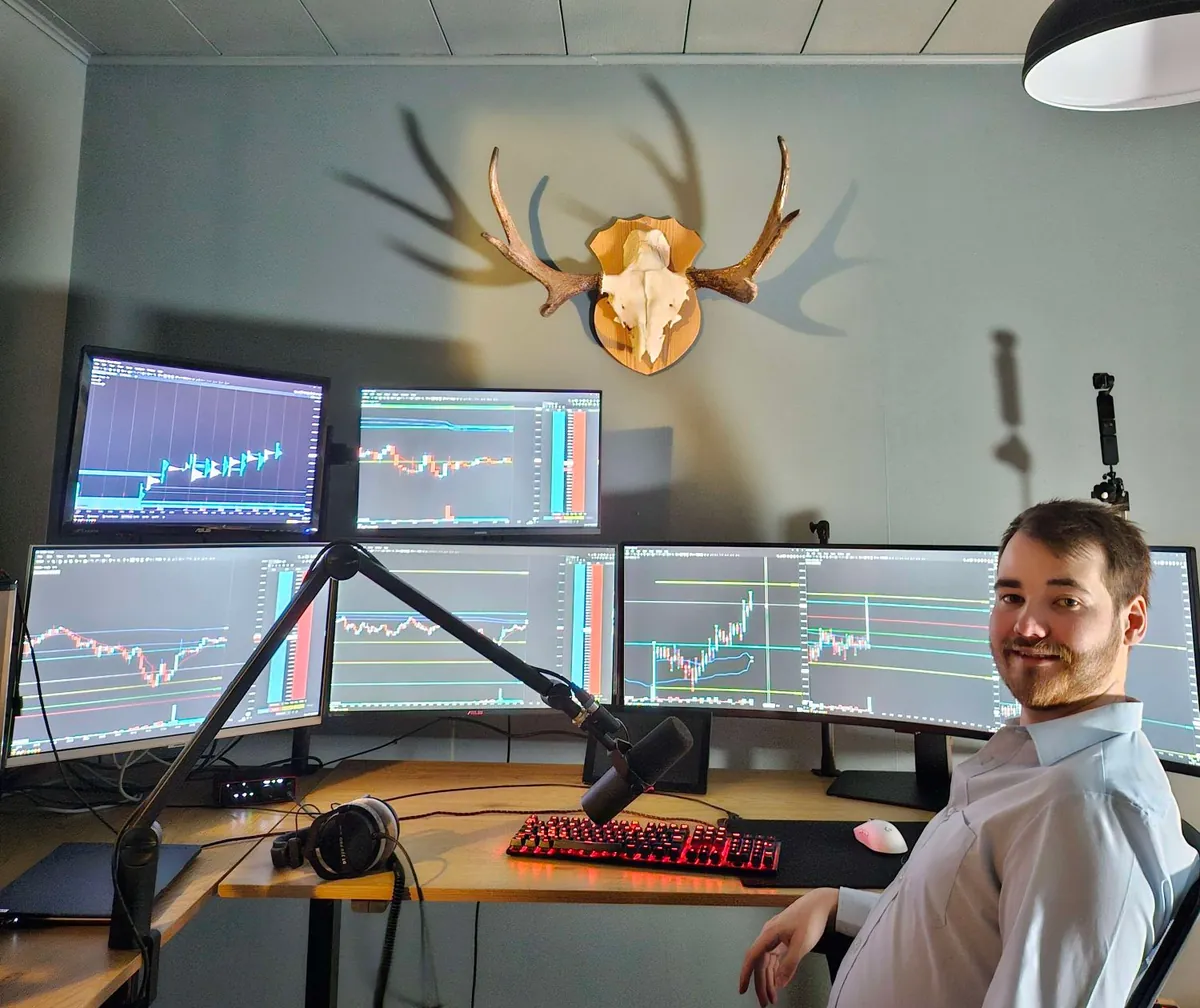
I'm the second kind. I'm not a psychologist. I'm a full-time futures trader, and I coach what I see in your trades.
If you want the background first, I wrote a full guide on trading psychology and what fixes it.
The short version
Session-based psychology coaches who publish a price mostly charge $500 to $1,000 a session. I coach the psychology side through your plan, your trades and your daily review, every day you trade. $1,600 for one month or $2,999 for three. Everyone starts with a $20 intro call.
Which Kind of Coach Do You Need?
It depends on where the problem shows up. This is how I'd split it.
| What's going on | Who I'd talk to |
|---|---|
| You have a setup and you keep breaking your own rules. Sizing up after a loss, revenge trades, trading past your daily limit. | A coach who trades and reads your trades every day. That's what I do. |
| You don't have a plan or a defined setup yet. Every trade is a guess, and after a loss the next guess feels as good as any other. | A trading mentor first. Get one setup written down before you work on the psychology around it. |
| You follow your rules and want to perform better under pressure. | A performance psychologist or a mental game coach. |
| It's spilling into the rest of your life. Losses follow you home, hurt your sleep or your relationships, or you're hiding them. | A licensed psychologist or therapist, and a real break from live trading. |
In my experience most traders are in the first row. Their psychology problems come from their process, and you can see that in the trades. Talking about how a loss felt is useful. Looking at why the size was double your rule is more useful.
What Trading Psychology Coaches Charge
These are the prices each coach publishes on their own site. I checked them on . Many don't publish a price, and I say so where that's the case.
| Coach | Background | Format | Published price |
|---|---|---|---|
| Jared Tendler | Mental game coach (MS, LMHC) for traders, poker players and athletes | One-hour sessions, mostly by phone or video | $750 first session, then $500 an hour. 3 sessions for $1,600. 10 hours for $4,500. |
| The Wall Street Coach (Kim Ann Curtin) | Trading psychology and performance coach. She writes that she doesn't give strategy advice. | 1-on-1 and group coaching, plus a written assessment | Assessment $1,295. She puts 1-on-1 coaching with an experienced coach at $500 to $1,000 a session and groups at $300 to $900 a month. |
| Stamford Psych (Dr. Reid Daitzman) | Licensed clinical psychologist in Connecticut | Appointments | None on the trading psychology page |
| Créde Performance (Créde Sheehy-Kelly) | Performance psychologist who started in sport | A program with live Q&A, and 1-on-1 consultations | None on the page I read |
| Trading Psychology Mentor | No coach is named on the site | One 60-minute audit, or five weekly sessions | None. You ask through the contact page. |
| Me (Joakim Jusell) | Full-time futures trader. I'm not a psychologist. | Comments on your plan, trades and review every day you trade, messages during the session, and a call at least once a week | $1,600 for one month, $2,999 for three |
I haven't worked with any of them, so I can't tell you how good they are. I can only tell you what they publish. If you want to compare trading mentors the same way, I put 18 programs side by side in trading mentorship programs compared.
How I Coach the Psychology Side
We don't sit down for a psychology session. You write three things each trading day in the Student Portal, and I comment on each one. That's where the psychology work happens.
The plan takes the decisions out of the moment
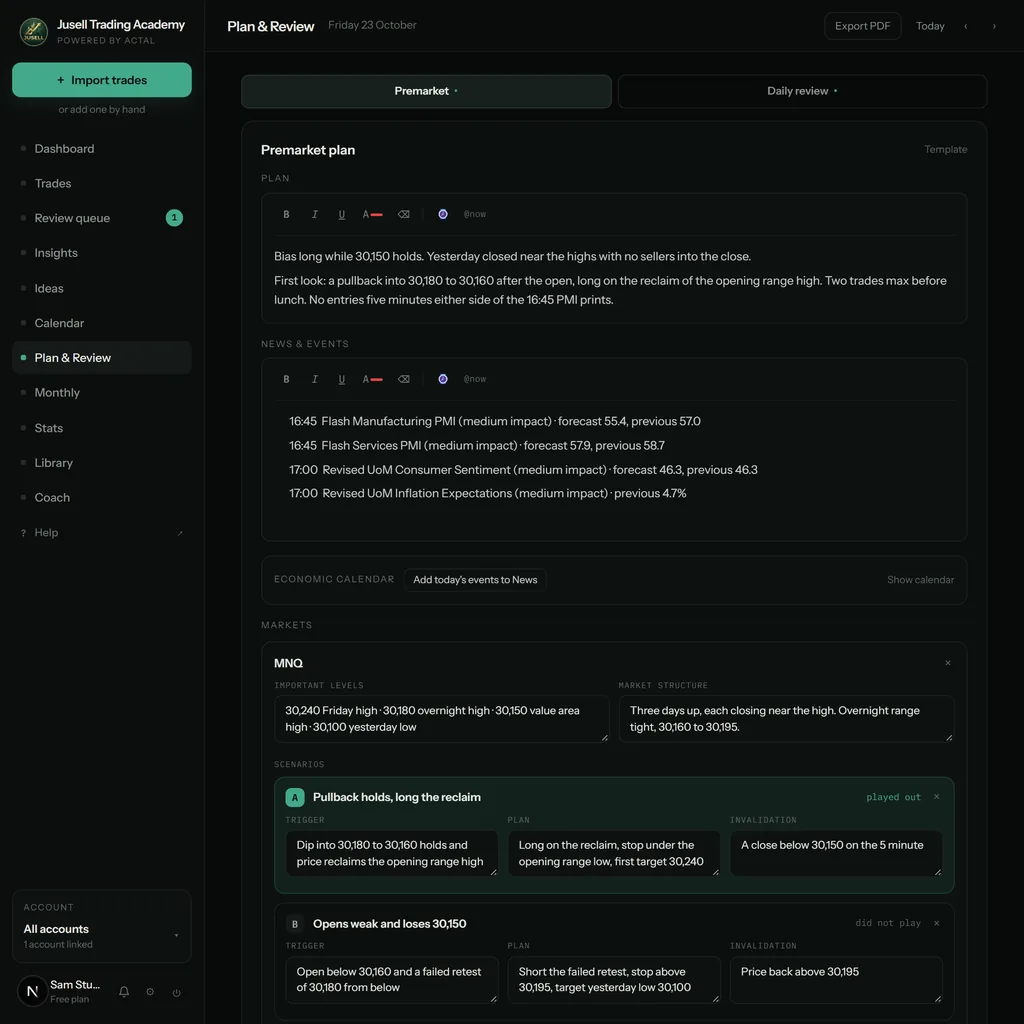
You write your levels, your scenarios and what has to happen at a level before you take the trade. The more specific you are, the fewer questions you'll have when it's time to take it. The moment is where emotions win, so we decide as much as we can before it.
Every trade is read against your rules
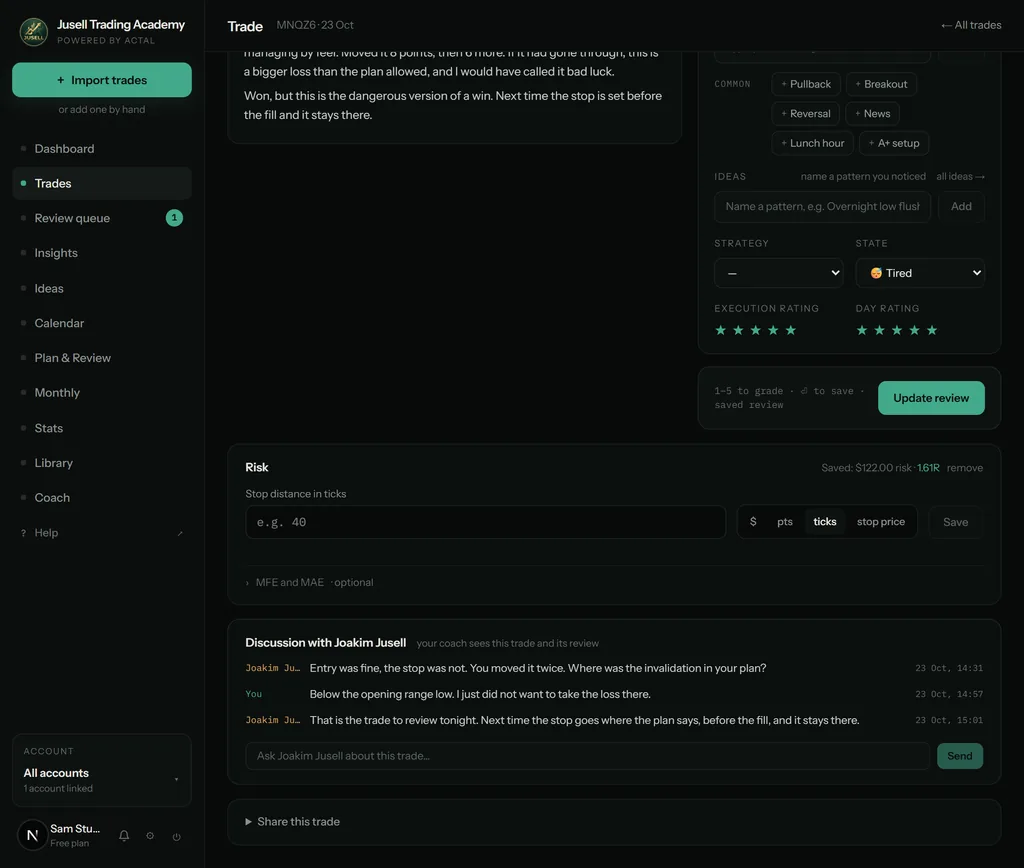
I go through your trades after my own session. What I look at is whether you followed your plan. A clean loss is a good trade. A winner that broke your rules is a bad one, because it rewards the rule break.
You put the day into words
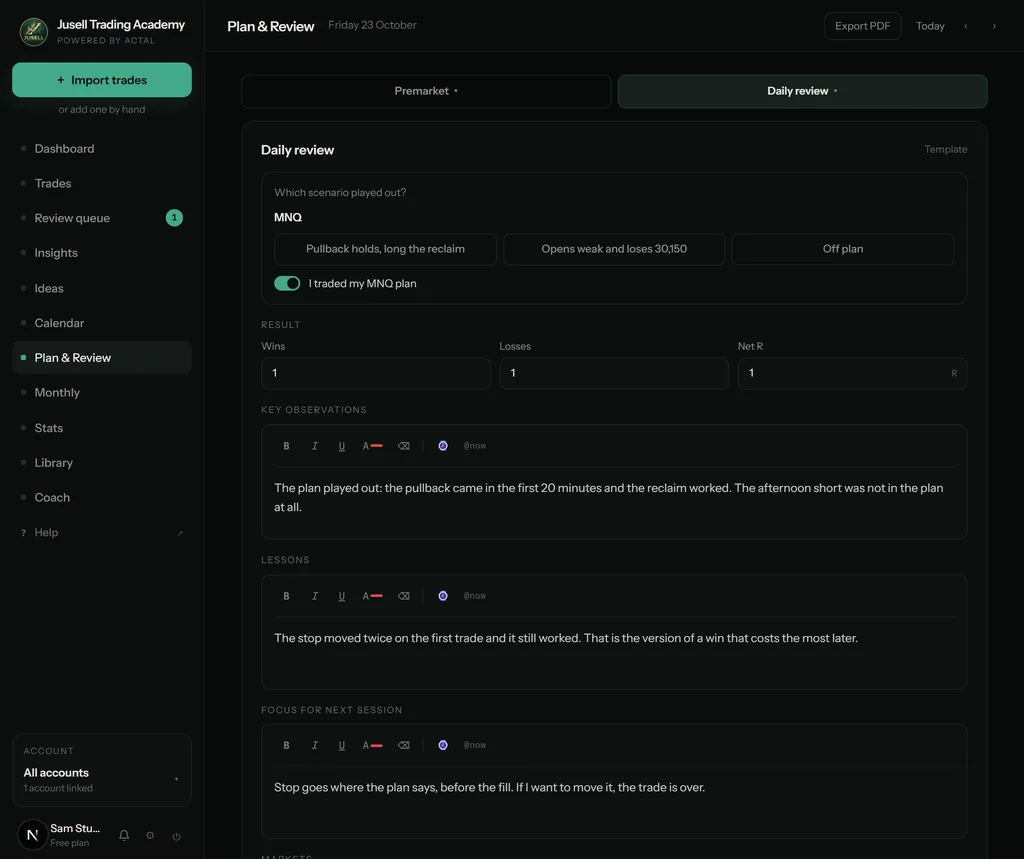
You write what played out, what you did and how you felt. If you were frustrated, I'll ask what the triggers were and what it felt like. When I'm on tilt my head feels heavy, like a small headache, so when that feeling creeps in I know to stop. I want you to find your own version of that.
You can message me during the session too, in the portal, on Discord or WhatsApp. We get on a call at least once a week, look at your numbers and pick what to change next. One thing at a time.
What My Feedback Looks Like
These are real comments I've left for students. I fixed the spelling and took out the details.
What We Work On
- Taking a loss. Size small enough that a normal loss feels boring, and reading a clean loss as a good trade.
- Revenge trading. Rules for what happens after a loss, and someone who checks them. My revenge trading guide has the six rules I give every student.
- Knowing when to stop. Daily loss limits, noticing when you're on tilt and ending the day on time.
- Following the plan. Rules you can check, and a review of every trade against them. More in my trading discipline guide.
- Prop firm pressure. If you trade a prop account, how to size against the trailing drawdown and the daily loss limit.
Who This Is For
A good fit
- You know what you should do and keep doing something else
- One bad day keeps taking back weeks of progress
- You keep failing prop firm evaluations
- You'll show me your trades and can take straight feedback
Not a fit
- You want talk sessions without showing your trades
- Trading is hurting your sleep, your health or your family. Please talk to a licensed professional first.
- The fee would eat your trading capital
- You want signals or guaranteed income
Not sure where you stand? The free trading diagnostic scores seven areas of your trading and names the one to fix first.
What My Coaching Costs
It's the same program as my trading mentorship. You can split the payment into up to three installments.
1-Month Mentorship
- Daily 1-on-1 coaching for a month
- Real-time trade guidance
- Trade reviews and feedback
- Student portal during your month: journal, trade recording, my feedback on every trade and plan
- 14-day money back guarantee, no questions asked
- Upgrade to 3 months anytime
3-Month Daily Mentorship
- Three months of daily 1-on-1 coaching
- Your own trading style, built with you
- Multiple daily check-ins
- Lifetime student portal access: your journal, your clips, every plan and review and all my feedback, kept for good
- Trade recording software included
- Lifetime Actal Pro when it launches
- 14-day money back guarantee, no questions asked
- Green Month Guarantee: do the work and no green sim month in 3 months, your 4th month is free
Why the $20 intro? I want to know for sure that we're a fit. In that hour we look at where you're stuck, and I'll tell you if coaching makes sense for you right now. If it wasn't worth your time, you can ask for the $20 back.
What Students Say
"The level of help and in depth coaching was amazing. Really helped to undo my bad habits."
Dominic W., United Kingdom"If you are looking for a magic box, this is not for you. If you are willing to put in the work and can dedicate yourself, Joakim will give you a much better chance to succeed than if you go it alone."
Paul P., United StatesRead every review in full on my reviews page, or on Trustpilot under real names.
Trading Psychology Coach FAQ
What does a trading psychology coach do?
A trading psychology coach helps you with the part of trading that happens in your head: fear, tilt, revenge trading and breaking your own rules. Some are psychologists or performance coaches who work on mindset and habits in sessions. Others are traders who coach it through your plan and your trades. I'm the second kind.
How much does a trading psychology coach cost?
The ones who publish a price are mostly between $500 and $1,000 a session. Jared Tendler lists $750 for the first session and $500 an hour after that. Many don't publish a price at all. My coaching is $1,600 for one month or $2,999 for three months, and that covers every day you trade.
Are you a psychologist?
No. I'm a full-time futures trader. I coach the psychology side through your pre-market plan, your trades and your daily review. If what you're dealing with is bigger than trading, a licensed psychologist or therapist is the right person, and I'll tell you that on the intro call.
Do I need a psychologist or a trading coach?
If the problem shows up in your trades, like sizing up after a loss or trading past your daily limit, a coach who trades and reads your trades can work on it with you. If losses follow you home, hurt your sleep or your relationships, or you're hiding them, talk to a licensed professional and take a break from live trading.
Can a coach stop me from revenge trading?
Nobody can promise that. What I can do is help you write rules you can check, read every trade against them, and tell you the same day when you broke one. My revenge trading guide has the six rules I give every student.
How long does it take to fix trading psychology?
One month is usually enough to find the problems. Changing the habits behind them takes longer, which is why most of my students pick three months.
Is a trading psychology coach worth it?
It can be if you already have a setup and keep losing money on rule breaks. It isn't if you don't have a plan yet, if you want signals, or if the fee would come out of your trading capital. I wrote more in is a trading mentor worth it.
Do you coach prop firm traders?
Yes, if that's what you trade. We work on what usually fails evaluations, like sizing against the trailing drawdown, daily loss limits and revenge trading. I can't promise you'll pass. The basics are in my prop firm evaluation guide.
Everyone starts with a one-hour call for $20. We'll look at where you're stuck and see if it makes sense to work together.
Book Your Intro Session ($20)
"Looks like you went 2 losses today and took a 3rd trade. That's a risk breach. I know the 3rd won, which makes it even worse because it rewards your rule break."
"Results don't matter. This was a perfectly executed trade, as you said. Be proud and remember this every time you take a new trade."
"Try to put that frustration into words. How did it feel? What were the triggers? For example when I feel tilt my head feels heavy, like a small headache. So when I feel this feeling creeping in I know to stop!"
"A normal issue with traders is that they try to fix everything at once. One thing at a time will take you far as long as you can consistently keep your focus on that!"