How to Pass a Prop Firm Evaluation: A Playbook From a Paid-Out Trader
Most eval guides are written by affiliate bloggers who don't trade. I trade live daily, use a funded Apex account to test new systems, and coach traders on the exact discipline evals are built to test. This is the playbook.
Updated · by Joakim Jusell
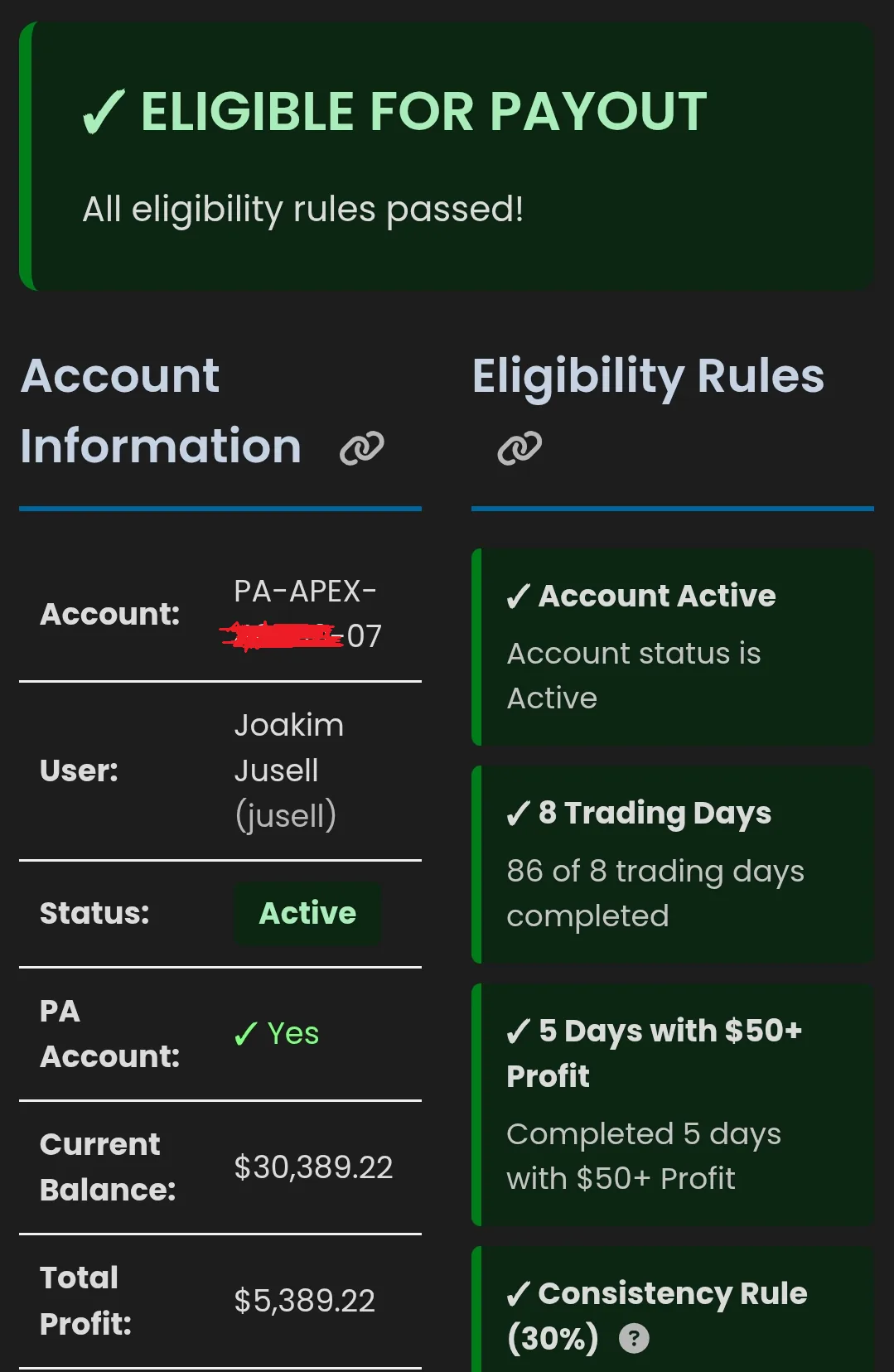
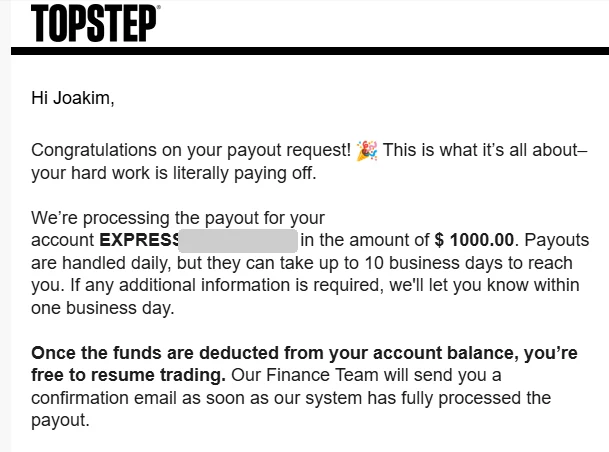
Quick context. I trade my own live account. The Apex account exists to test new systems before they're allowed near real money. Eighty-six trading days on it, every payout rule passed, and two payouts approved in July 2026. I've been getting paid by prop firms for over a year now, Topstep back in April 2025 and Apex since. The proof is below, because a prop firm guide from someone who's never been paid isn't worth much.
If you're still choosing a firm, I compare the two I've been paid by in Apex vs Topstep. I'm not affiliated with Apex or any prop firm and there's no discount code on this page. My students don't trade prop accounts either. But passing an eval takes the same things I coach every day: sizing, handling red days, and following your own rules when nobody's watching.


Two Apex payouts approved in the same month: $1,500 on July 6 and $1,500 on July 27, 2026.
One more thing before the playbook: prop firm rules change constantly. The specifics below are accurate for Apex as of July 2026. Always read the firm's own help center before you pay for anything. If a rule here contradicts their site, their site wins.
Why Most People Fail Evals
Almost nobody fails because the profit target was too hard. On a 50K Apex account the target is $2,500, and any halfway decent trader gets there eventually if the account survives long enough. That's the catch. Most accounts don't survive long enough.
I've watched this movie so many times I can quote it. A guy buys an eval, trades it like it's his own fifty grand, takes two losses before lunch, and now he's pressing size to get back to flat before dinner. By Wednesday the account is breached. So he buys a reset, and the same week repeats itself. The firms know this loop better than anyone, resets are half the business model.
So no, I don't have a secret strategy for you. The rules were written to catch impulsive, oversized trading, because that's what most people turn into under pressure. If you can manage to not be that person for a few weeks, you've already beaten most of the field.
Gambling Is a Behaviour, Not a Market
People love telling me futures are basically gambling. I don't think the market decides that. You do, by how you trade it. You can gamble on ES just as easily as at a roulette table, and the way evals get sold makes it really easy to slide into.
Think about how it usually goes. The eval is on a big sale, so it feels like a lottery ticket. You go max size the first morning hoping to pass before lunch. It blows up, and five minutes later you've bought the reset, maybe two more evals while you're at it because they're cheap. I blew my own first account doing basically the same thing with real money, so I'm not pointing fingers. But be honest with yourself, none of that was trading. It's casino behaviour with a chart open.
When a student tells me about their eval history, that's what I'm listening for. Sizing up because "it's not real money". Resetting within minutes of a breach. Trading the news to get it over with. And almost always, no written rules, so every decision got made on the spot by whatever mood they were in.
A new strategy won't fix any of that. Rules you set before the open will, plus the habit of sticking to them when it gets uncomfortable.
Know the Rules Before You Pay
For Apex specifically, the structure right now looks like this. One-step evaluation. Profit target is 5% of account size. No minimum trading days, so you can technically pass in a day. Thirty calendar days of access per billing cycle. No consistency rule during the eval itself. Then once you pass, you get seven days to activate the funded account, and that's where stricter rules kick in: payout minimums, a consistency rule, and activity requirements to keep the account alive.
The rule that actually decides your fate is the trailing drawdown, and you get a choice: end-of-day trailing or intraday trailing. I break both down with worked numbers in trailing drawdown explained.
Take the EOD version. With EOD, your drawdown threshold only recalculates at market close. Intraday trailing follows your peak balance in real time, unrealized profit included, which sounds harmless until you're up $400 on an open trade, it comes back to +$150, and your threshold already ratcheted up off that $400 peak. You just got punished for letting a winner breathe. EOD doesn't do that to you, and it suits anyone who manages trades like a human being instead of a scalping bot.
The Math That Passes Evals
The 50K on the label is marketing. What you actually have is $2,500, the drawdown, and once you start thinking of that as your real account everything else falls into place on its own.
The sizing rule I give students works the same here: risk a small fixed slice of whatever your real capital is, and in an eval your real capital is the drawdown. Call it 5%, so $100 to $125 a trade on a 50K Apex. That buys you over twenty full losses in a row before you're out, and nobody with an actual setup loses twenty in a row. The guy risking $500 a trade is done after four bad ones. And four bad trades in a row is just a normal Tuesday sometimes.
At $100 risk with a sensible stop you're trading one or two MES or MNQ contracts, maybe a single ES if your stop is tight. It feels painfully slow, I know. Two or three weeks to the target instead of two days. But nobody is timing you, and passing fast with size you can't repeat just means the funded account collects on it later. It's the same risk management framework I teach, pointed at someone else's ruleset.
Write Your Rules, Then Practice Following Them
Most people who fail evals already know what they should be doing. They've seen the videos, and some of them could explain risk management better than half the coaches out there. They just can't do it at 10:15 after two red trades. That part is a skill, and you get better at it the same way you get better at anything, by practicing it.
So before you spend a cent on an eval, write your system down. It doesn't have to be fancy, one page is plenty. What you trade, which setup, where the stop goes, how much you risk, when you stop for the day. If it only lives in your head you'll end up renegotiating it with yourself mid-session, and you'll lose that argument every time.
Then trade it on sim until following it feels boring, and grade every trade on one thing: did I follow my rules? Not whether it made money. A loser that followed the plan is a good trade. A winner where you moved your stop is actually a bad one, because it teaches you the wrong thing.
It's exactly what we do in my mentorship program. Everyone builds their own written rules and trading plan, and when I go through their trades I'm checking them against those rules, not the P&L. We fix the rule-following first and the results come after. Same thing that gets an eval passed.
The Actual Playbook
Here are the rules I'd write for a fresh 50K eval today, start to finish.
One setup, one market. Pick your best setup and trade only that. Mine would be an orderflow entry at a pre-marked level on ES. If you don't have a defined setup yet, you're not ready to pay for an eval. Go build one on sim first. It's free.
Pre-market prep, every day. Mark your levels before the open, write down what you're willing to take and what you're not. My students do this in the portal every morning, and five minutes of it kills most of the dumb impulse trades before they ever happen.
Two trades a day, max. A green trade or two red ones and I'm done for the day. I'm convinced this one rule would save more evals than any strategy tweak, because accounts almost never die on the first bad trade. They die on trade five of a tilted afternoon, which is exactly what revenge trading looks like.
Bank the day early when it's there. Up $150 to $200 on a 50K eval? Strongly consider being done. With EOD trailing, every close in profit locks progress in. Grinding to the target in $150 days feels slow until you realize it's ten green days and you never once risked the account.
No trading the first minute of news. I blew my first personal account on a CPI print, so I get to say this one with a straight face. The spread widens, stops slip, and your neat little risk math stops being math.
Journal every trade. Not for the prop firm's sake, for yours. The journal is how you catch yourself drifting from your own rules before the account catches it for you. Mine is free if you don't have one. For the journal side of eval prep and the current Topstep and Apex rules, see my guide to passing a prop firm evaluation on the Actal site.
Don't Buy a Reset Until You've Fixed the Root Cause
If you breach, do not buy the reset the same day. I mean it. The reset button exists because firms know exactly what a trader feels like ten minutes after blowing an eval, and that trader is the most profitable customer they have.
Take the evening. Read the journal. Find the trade where it actually went wrong, which is almost never the last trade. It's usually the second one, the one where you doubled size to get back to flat. Fix that rule, then reset and go again. Paying for a reset after you've fixed the actual leak is fine, that's tuition. Paying for one while you're still angry is a donation to the firm.
Before a student resets, I make them answer one question: what actually went wrong, in one sentence, and what's the rule that stops it next time? Something like "I doubled size after two losses, so size never goes up after a red trade again." If they can't write that sentence, they're not ready yet, and the next eval usually goes the same way.
And if you've bought three resets for the same mistake, be honest about it. It's a pattern by now, and the firms are counting on it. Breaking it costs you one honest evening with your journal.
Passing Is the Easy Part
Something the affiliate blogs tend to bury: the eval is the loose part of the whole system. No consistency rule, no minimum days, pass whenever you want. All the strict rules live on the funded side. Consistency requirements on payouts, minimum activity to keep the account alive, a safety net threshold you have to respect.
Which means if you pass with a style that can't survive those rules, you haven't really won anything, you've pre-paid for a second and more expensive failure. Trade the eval the way you'll have to trade the funded account. Same size, same setups, same daily stop. Treat the whole thing as a rehearsal for the account that actually pays you.
And if you keep failing evals the same way over and over, the problem usually isn't the prop firm. It's the process, and process is fixable. That's most of what I do all day with students. Daily 1-on-1 coaching means someone watches you trade and calls out the rule you're breaking while you're breaking it, instead of three days later in some review call.
A Warning Before You Buy One
Prop trading has a side the industry doesn't like talking about. Done wrong, it trains gambling habits. Evals cost a hundred bucks or so, resets are cheap, and you can run a pile of accounts at the same time if you feel like it. At some point losing stops feeling like losing and starts feeling like a subscription fee. And when losses stop hurting, you stop learning anything from them. I've seen people burn more money on evals and resets in a year than a careful live account would ever have cost them, and they built worse habits while doing it.
This is a big part of why my students learn on sim and then move to their own live accounts instead of prop. Your own money teaches you respect in a way rented money never will. One micro contract of your own feels heavier than a 150K eval that resets for eighty bucks, and the habits you build with real skin in the game are the ones that actually stick. Prop accounts are a tool. Great for cheap size once you already have discipline, and that's exactly what I use mine for, testing systems. But as a place to learn discipline in the first place, live trading small is usually the safer road.
Questions I Get About Evals
How long does it take to pass a prop firm evaluation?
Apex has no minimum trading days, so on paper you can pass in one afternoon. Done properly with small risk, expect one to three weeks. And honestly, if you're passing evals in a day you're oversizing, and the funded account will collect on that later.
Should I pick EOD or intraday trailing drawdown?
EOD, almost every time. It only recalculates at the close, so an open winner that pulls back doesn't drag your threshold up in real time. Intraday trailing punishes you for holding winners. About the only people who should consider it are scalpers who flatten everything within seconds anyway.
How much should I risk per trade in an evaluation?
Work off the drawdown, not the account label. On a 50K Apex that's $2,500 of real capital, and risking around $100 to $125 a trade means you can be wrong twenty times in a row before you're out. Nobody with an actual edge loses twenty in a row.
Is passing the evaluation the hard part?
No, and that surprises people. The eval has the loose rules. The funded account has the strict ones, consistency, payout minimums, activity requirements. Pass the eval in a way you can repeat under those rules, or you've just rented a more expensive way to fail.
Should I buy a reset after failing a prop firm evaluation?
Only after you've found the root cause. Read your journal, find the trade where it really went wrong, and write one new rule that stops it happening again. If you can't name the cause in one sentence, a reset just buys you the same failure again.
Is trading a prop firm evaluation gambling?
It can be, depending on how you trade it. Going max size to pass in a day, buying resets on impulse and trading without written rules is gambling behaviour. With a written system, a fixed risk per trade and a daily stop, it becomes a skill test you can actually prepare for.
Tired of donating reset fees to prop firms?
See 1-on-1 MentorshipMore from the Academy: Risk Management • Free Trading Journal • Pre-Market Checklist • Orderflow Entries • About Joakim • All Free Resources