My Trading Philosophy: What Makes My Mentorship Different
How I trade, how I coach, and why I ended up building my own journal and trade recorder to do it.
People ask me what makes my mentorship different. The short answer is that I don't care much about how a trade felt. I care about what you actually did, whether it followed your rules, and what the numbers say over your next fifty trades. Everything I've built comes from that.
Here's the longer answer.
Feelings Are a Bad Scoreboard
After a trade you remember a version of it. A winner feels like you did it right. A loser feels like you did it wrong. Half the time both are false.
I learned that the expensive way. My first account went to zero in a few weeks. No stops, no idea what CPI was, and every trade felt like a good idea when I took it.
Any single trade is a coin flip with an edge. You can do everything right and lose, and do everything wrong and win. So I don't judge a trade by the money. I judge it by whether you followed your plan. Mark Douglas put that idea in my head years ago and it's still the base of how I coach. I wrote about him and the other traders who shaped how I teach.
Grade the Execution, Not the Result
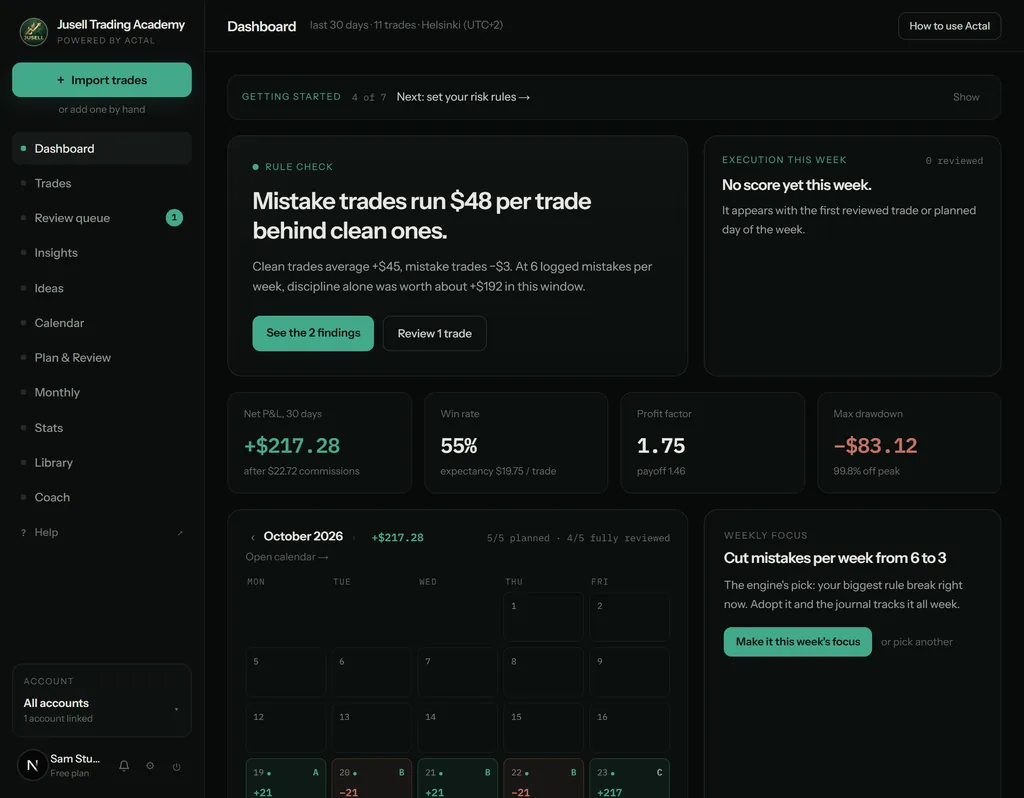
Every trade my students take gets a grade from A to F, and the grade is for how you traded. You followed the plan and lost? That's an A. You moved your stop and got lucky? That's a D.
It sounds like a small thing. It isn't. If you reward lucky wins, you train the exact habit that blows the account later. If you punish clean losses, you train yourself to hide them.
That's also why we spend more time on losses than on wins. How you lose tells me where you really are.
Habits First, Then the Numbers
I'm a bit obsessed with habits. A rule you follow 80 percent of the time isn't a rule. And the other 20 percent is usually where the money goes.
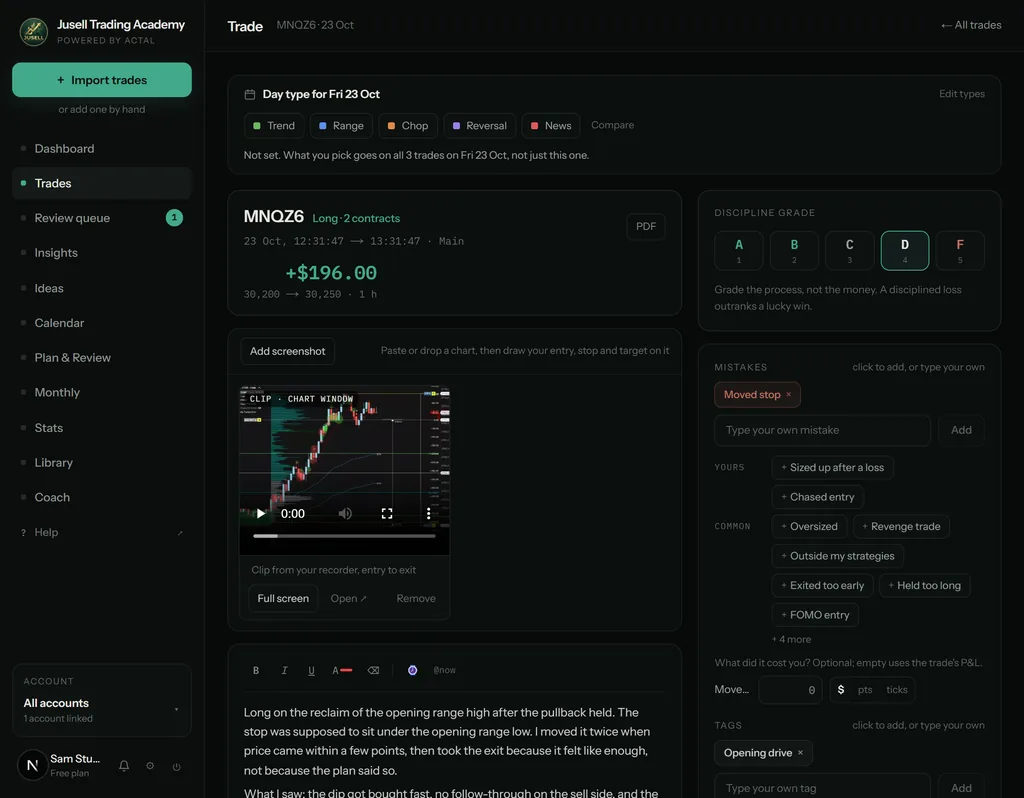
You check a habit with numbers, not with how the week felt. FuturesTrader71 taught me to treat trading like a sport and keep stats on myself. So my students know their own numbers: win rate in the first hour against the afternoon, which setup pays for the month, and what each kind of mistake cost them in dollars. When the journal shows you what moving your stop cost you last month, you stop arguing with yourself about whether it matters.
Your risk rules are checked against every trade: daily loss limit, max size, max trades, cooldown after a loss. Break one and the journal flags it. I see it the same day.
Then we fix one thing at a time. Every week we look at the numbers and pick the one habit to work on next. Usually it's risk, patience or revenge trading.
Why I Built My Own Journal
I used trading journals for years. They were good at showing P&L, win rate and pretty charts. None of them focused on what actually mattered: did I execute my plan, did I follow my rules, and what did it cost me when I didn't.
When I started coaching I hit the same wall from the other side. Calls and messages weren't enough. I needed to see every trade, the plan before it and the review after it, in one place. So I built the Student Portal.
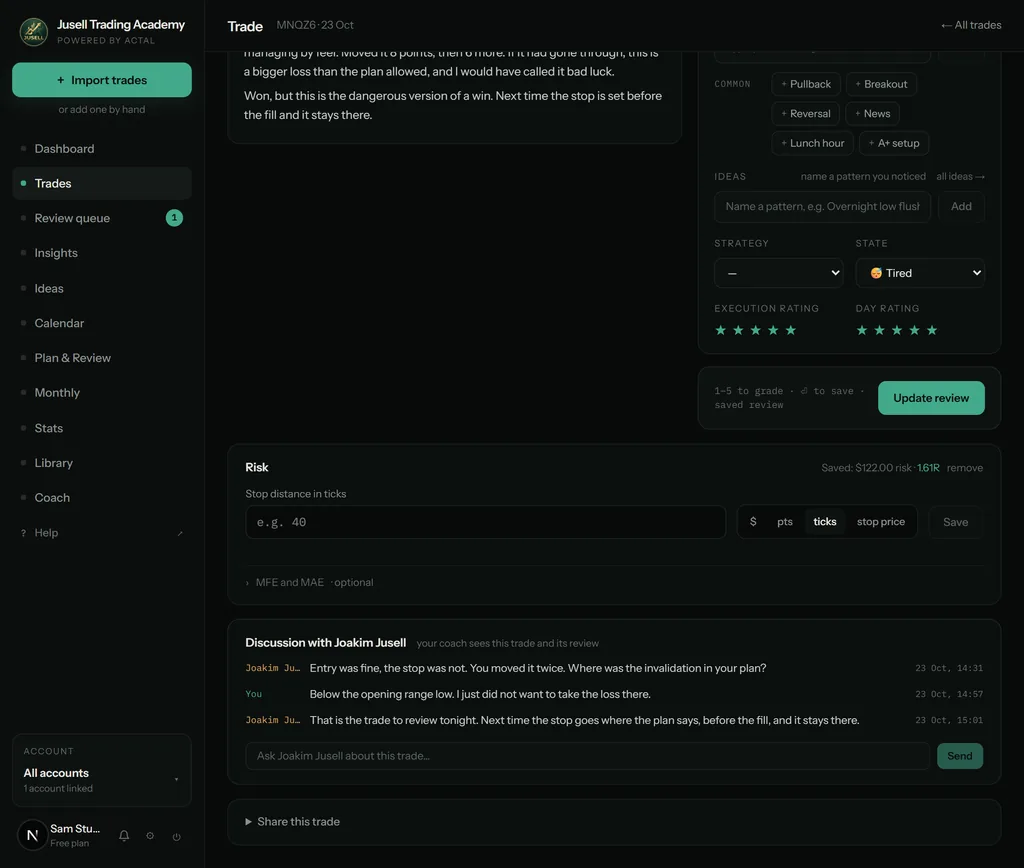
Today the portal runs on Actal, the trading journal I built. Students import their trades straight from their broker, so nothing gets typed in and nothing gets left out. Every trade, plan and daily review has a comment thread where I leave feedback and the student answers. It stays on that trade, so when the same mistake comes back two months later, the old conversation is still right there.
Recording Every Trade
Even with a good journal there's one weak spot. The review is still your memory of the trade, and memory is generous. You remember a clean entry. You don't remember hovering over the button for two minutes, or dragging the stop twice.
So I built a recorder. It's our own software. It runs on your PC and films your chart while you trade. After you import the session, every trade gets its own clip from a minute before the entry to a minute after the exit, saved on the trade. When we review, I watch what you did.
It's built to be light. It records the chart at five frames a second, so it doesn't slow your platform down when the market gets fast. Nothing leaves your computer except the clips you pick.
Always Improving
I use the same journal and the same recorder on my own trading, and I grade my own trades the same way I grade my students'.
The tools keep changing too. When students keep running into the same problem, I change the journal so it catches it earlier. The coin flip exercise is a good example of how I think. Before we argue about whether your read has an edge, we test it against a coin and log the results like any other trade.
None of this is finished, the tools or my own trading. I work on both every week.
Five Students, and Where This Is Going
I only take five students at a time. That's how many I can properly follow, every trade, every day.
The long-term goal is my own fund. When that happens I want traders around me who have the habits and the numbers to back it up, and this is how I'd want them trained.
What This Looks Like If You Work With Me
- Your plan checked before every open.
- Every trade imported from your broker, graded on execution and commented by me.
- Your trades on video, from entry to exit.
- Your risk rules checked against every trade.
- One thing to fix each week, picked from your own numbers.
- A weekly live call.
If that's what you're looking for, book an intro and we'll see if it's a fit.
Want this applied to your trading, every day?
See 1-on-1 MentorshipMore from the Academy: About Joakim • Trading Influences • Risk Management • Revenge Trading • Free Trading Journal • All Free Resources